Somewhere in the next few weeks, every obligated dairy processor in Britain will receive a Notice of Liability for the second year of extended producer responsibility. It will be priced per tonne, per material, and this time it will be priced by how recyclable the packaging is.
The odd thing about this bill is the order in which the information has arrived. The penalty is published. The price is not.
Producers had until 1 September to resubmit their 2025 packaging data. PackUK locks the figures after that and issues the Notices. Confirmed year-two fees were expected in June and, as of the start of this month, had not been announced. What exists in the meantime is an illustrative table published in December, and a modulation policy that has been settled since June of last year.
Most of the sector is waiting for the rate. That is the wrong thing to wait for, and this piece is an attempt to show why by working the arithmetic in public.
What this piece can honestly do, and what it cannot
Two rules, stated up front, because they govern every number below.
The tonnage is illustrative. We considered using a real processor's pack mix anonymously. We did not secure one in time, so nothing here is disguised reporting on a named business. The mix below is stated, not observed. If your own mix differs, and it will, the method still holds.
Every rate is published. None is derived. You will not find a figure in this piece produced by multiplying a base rate by a modulation factor. The multipliers are confirmed while the rates they attach to are not, so their product would be a guess dressed as arithmetic. Everything below is either a published rate, a tonnage, or the difference between two published rates.
That second rule has a consequence worth stating plainly. The published illustrative table gives all three ratings for plastic: £415 a tonne green, £455 amber, £545 red. For most other materials it gives the amber rate only. So the honest worked example is a plastic example. Fibre-based composite, which is the most expensive material in the year-one table at £461 a tonne, is where much of the dairy sector's risk actually sits, and it is precisely where we cannot yet show you the spread. That is a gap in the public record, not a gap in the analysis.
The illustrative processor
Take a mid-sized liquid milk and cheese business placing 400 tonnes of plastic packaging on the market in a year. Bottles, caps, film, pots and lidding. Stated illustratively.
Three versions of the same 400 tonnes, at the published illustrative year-two rates:
| Scenario | Rate | Fee on 400 tonnes |
|---|---|---|
| All green-rated | £415/t | £166,000 |
| All amber-rated | £455/t | £182,000 |
| All red-rated | £545/t | £218,000 |
The distance between the top and bottom of that table is £52,000 a year on an identical tonnage of an identical material. Nothing in it is our arithmetic. It is the published table multiplied by a stated weight.
Now a realistic split rather than three extremes. Say 250 tonnes of HDPE bottles rated green, 120 tonnes of mixed rigid formats rated amber, and 30 tonnes of multi-layer film and lidding rated red.
| Component | Tonnes | Rate | Fee |
|---|---|---|---|
| Green formats | 250 | £415/t | £103,750 |
| Amber formats | 120 | £455/t | £54,600 |
| Red formats | 30 | £545/t | £16,350 |
| Total | 400 | £174,700 |
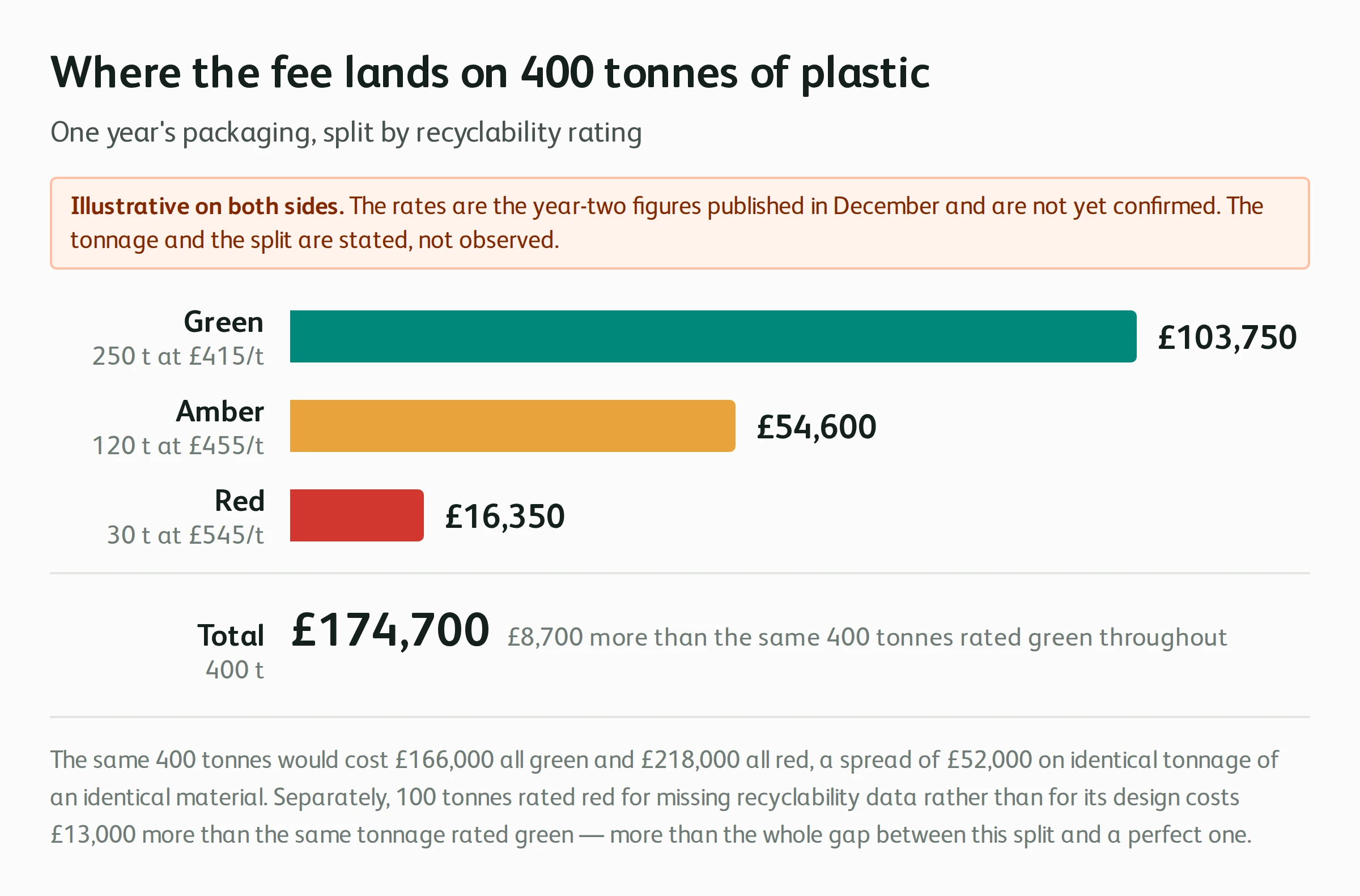
Against an all-green version of the same business, that is £8,700. It is not a catastrophe. It is also not nothing, and it is recurring, and the multiplier attached to the red line rises to 1.6 in 2027/28 and 2.0 in 2028/29 on a published schedule.
There is a second number in the same table that nobody has budgeted for. Year one charged plastic at £423 a tonne flat. The illustrative year-two amber rate is £455. On 400 tonnes, that difference alone is £12,800 before a single rating is taken into account. The rating conversation has been so loud that the rate rise underneath it has gone largely unremarked.
Where the avoidable money actually sits
Here is the finding that made this piece worth writing.
Household packaging in scope of the methodology that has not been assessed, or where the detail required to undertake an assessment is not available, is an automatic red.
That is not an inference from the fee tables. It is written into the RAM itself, in the list of automatic reds, alongside intentionally added PFAS and substances of very high concern.
Not red because it is hard to recycle. Red because nobody submitted the assessment. Same pack, same material, same recycling route, different number on the invoice.
Run that through the illustrative business. Suppose 100 tonnes of packaging that would otherwise rate green goes in without a completed assessment and lands on the red rate instead. The difference between £415 and £545 on 100 tonnes is £13,000.
That is larger than the entire gap between the split scenario above and a perfect all-green portfolio. The single most expensive packaging decision available to a mid-sized processor this year is not a material decision at all. It is whether a form was completed, by someone, on time.
Three moves follow from that, in order of return:
One. Find the red-by-default tonnage before you find the red-by-design tonnage. It is cheaper to fix and it requires no capital. Ask for a line-by-line list of every SKU whose recyclability assessment is incomplete, and treat the list as a finance document rather than a technical one.
Two. Establish who owns the rating. In most businesses this number is currently split three ways. Procurement specifies the pack, sustainability holds the recyclability data, finance receives the invoice, and none of the three can see the other two. The rating is the mechanism that converts a specification into a cost. It needs one owner with a name.
Three. Sequence redesign against the multiplier, not against the rate. You cannot model the bill, because the rate is not published. You can model the escalation, because it is. A red format that is uneconomic to fix at 1.2 may be straightforwardly economic at 2.0, and the 2.0 year is 2028/29. That is inside the normal repack cycle for most dairy formats, which means the decision is live now even though the cost is not.
The larger version of the same question
Packaging fees are one instance of a pattern that runs through this pillar. A waste stream acquires a price, and once it has a price someone can build a case for treating it as a stream rather than a cost.
The most cited British example at processor scale is the cheese creamery at Aspatria in Cumbria, where an anaerobic digestion plant was built to run on the site's own process residues. It was described at the time as the first dairy processing site in Europe to inject biomethane into the gas grid, with feedstock drawn from low-strength wash waters and process rinses supplemented by whey permeate. The revenue case rested substantially on long-term, index-linked, government-backed incentive payments under the Feed-in Tariff and the Renewable Heat Incentive.
That last sentence is the reason we are not presenting it as a template.
Those two schemes are closed to new entrants. A processor evaluating the same investment today is looking at a different support regime, and the honest position is that we have not yet verified what the equivalent case looks like under current conditions, at current capital costs, on current gas prices. Reprinting a 2015 business case in 2026 and calling it evidence would be exactly the failure this series was set up to avoid.
So the section closes as a question rather than a case study, and as an open invitation. If you have built a water, heat or effluent recovery case at processing scale in the last three years, with numbers you can stand behind, we will publish it with your name on it. Pillar Five returns in November, when the fees fall due, and that is where the answer belongs.
The decision before the Notice arrives
An operations director reading this has perhaps six weeks, and cannot know the price.
What they can know, this month, without waiting for PackUK, is how their tonnage splits across green, amber and red, and how much of the red is red for administrative reasons. That is a list. It can be produced from existing data. It requires nobody's permission and no capital.
When the Notice of Liability lands, the businesses that did that work will be checking an invoice. Everybody else will be reading one.
Sources & data
- Defra, Environment Agency and Natural Resources Wales: Recyclability assessment methodology — how to assess your packaging waste (RAM version 1.1, April 2025; page last updated 4 September 2025). Automatic reds include any household packaging in scope of the RAM which has not been assessed or where the detail required to undertake an assessment is not available
- The Producer Responsibility Obligations (Packaging and Packaging Waste) Regulations 2024, SI 2024/1332, regulation 64(8): where a liable producer has not provided sufficient information, the scheme administrator is to treat that packaging as having the same degree of environmental sustainability as the least environmentally sustainable household packaging in that packaging category
- PackUK: 2025 recyclability assessment requirements (published 27 June 2025), which applies regulation 64(8) as the Red RAM subcategory disposal fee and sets the H1 and H2 2025 recyclability assessment deadlines
- PackUK: illustrative year-two modulated disposal fees published December 2025 — plastic £415 a tonne green, £455 amber, £545 red
- PackUK: confirmed year-one base fees — fibre-based composite £461 a tonne, plastic £423, glass £192
Published by The Dairy Mail, Dairy Connect: https://www.dairy-connect.com/the-dairy-mail/the-invoice-arrives-this-autumn/